A Historical Continuum of Japanese Long-Weapon Arts: Sojutsu, Jojutsu, and Aiki-jo
Jo 杖 (staff) and yari 槍 (spear) represent some of the most sophisticated long-weapon systems in Japanese martial arts. Among these, Hozoin-ryu Sojutsu 宝蔵院流槍術, Shindo Muso-ryu Jojutsu 神道夢想流杖術, and Aiki-jo stand out for their historical depth, technical refinement, and lasting influence in the history of long-weapon practice. All three remain among the most widely practised long-weapon arts in Japan today. Understanding their origins and relationships provides valuable insight into how Japanese weapon arts evolved from battlefield combat to modern practice.
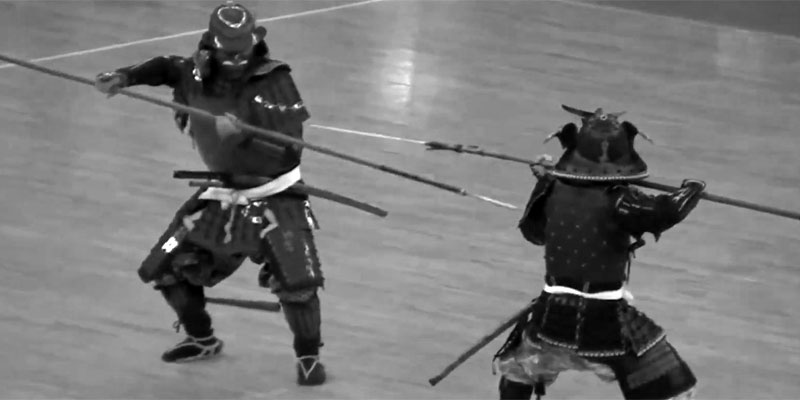
Sojutsu is the classical Japanese art of the spear. Over time, the yari replaced earlier long weapons such as the hoko 矛 and naginata 薙刀, rising to prominence on the battlefield during the Muromachi and Sengoku periods (14th to 16th centuries). The spear was used extensively by ashigaru 足軽 (foot soldiers) and proved highly effective in formation fighting due to its reach, thrusting power, and adaptability. Hozoin-ryu is one of the most renowned schools of sojutsu, founded in the sixteenth century by Hozoin Kakuzenbo In’ei 宝蔵院 覚禅房 胤栄, a Buddhist monk of Kofuku-ji 興福寺 (a temple) in Nara 奈良. (Note: Hozoin is the sub-temple name, and Kakuzenbo is a religious title rather than a personal name.) Hozoin-ryu is best known for its use of the jumonji-yari 十文字槍, a cross-bladed spear designed for thrusting, hooking, and weapon control. Training emphasizes strong posture, long-range dominance, precise thrusts, and control of ma-ai 間合い (combat distance), reflecting a battlefield mentality in which structure and decisiveness were critical to survival.
Hozoin-ryu sojutsu with the practice used jumonji-yari
Shindo Muso-ryu Jojutsu is a classical koryu jojutsu system founded in the early Edo period by Muso Gonnosuke 夢想權之助. Although the jo itself was not invented by Gonnosuke, he formalized and systematized its use as a martial weapon. As Japan entered a prolonged era of peace, the sword replaced the spear as the primary personal weapon, and jojutsu emerged as a practical method of countering sword attacks. Jojutsu preserves many spear-derived mechanics in a shorter weapon without sharp blades, including linear thrusts, angular footwork, sweeping strikes, and pins. Its kata training focuses on clarity, timing, and decisive resolution against a sword-armed opponent, positioning Shindo Muso-ryu as a bridge between battlefield spear arts and later systems emphasizing refined control.
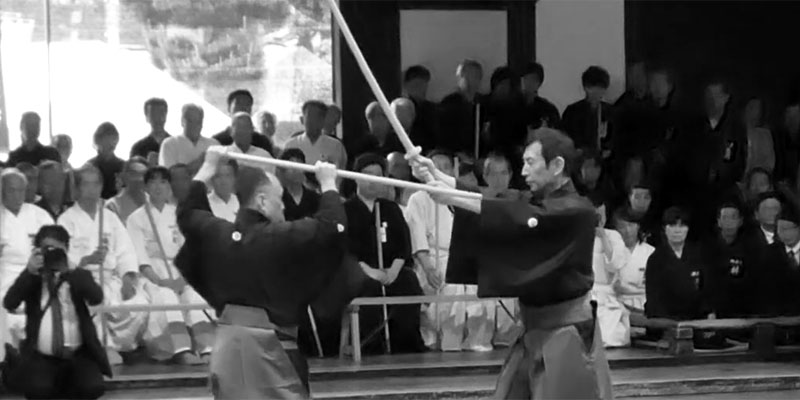
Jodo demonstration against sword attack
Aiki-jo is a modern weapon practice associated with Morihei Ueshiba, the founder of Aikido. Unlike classical jojutsu schools, Aiki-jo does not claim a single formal lineage. Instead, it reflects Ueshiba’s synthesis of principles drawn from the spear, the jo, the juken 銃剣 (a modern military weapon evolved from the spear), and empty-hand techniques. While Ueshiba may have had some exposure to Hozoin-ryu or Shindo Muso-ryu, there is no historical record indicating that he formally studied either system.
Aiki-jo shares fundamental characteristics with spear and jo movement, including extended lines, spiralling power, and unified body mechanics. However, its emphasis shifts away from direct opposition toward aiki principles such as blending, connection, and balance breaking. In Aikido practice, the jo is used not only as a weapon but also as a training tool for studying posture, distance, timing, and internal coordination. Empty-hand techniques against a jo-armed opponent are likewise practised. For Ueshiba himself, the jo also served as a medium through which spiritual ideals could be embodied in physical form; he regarded it as a means of expressing the connection between the practitioner’s body and the universe.
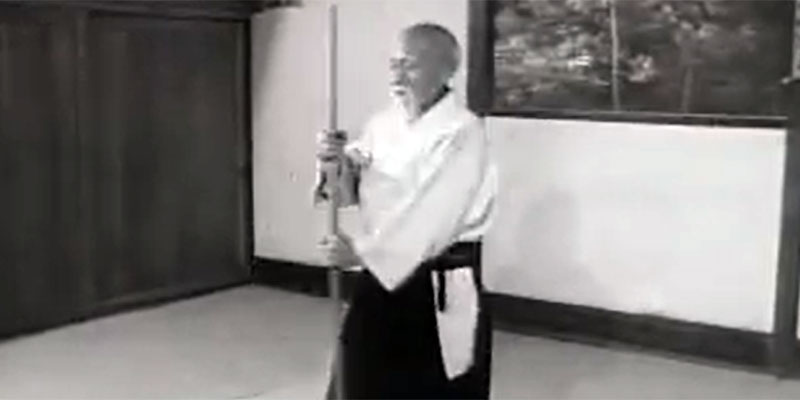
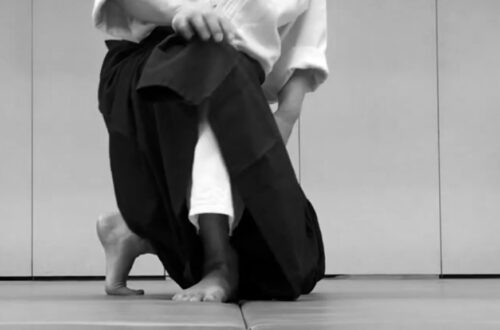
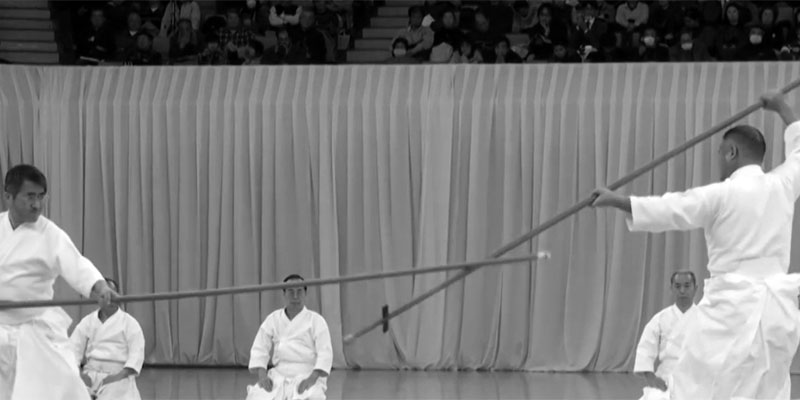
Ueshiba incorporated spiritual elements into his jo practice
Rather than developing in isolation, these arts form a continuum of influence. Sengoku-era spear traditions such as Hozoin-ryu established foundational principles of distance, structure, and power. Shindo Muso-ryu refined those principles into a shorter weapon system suited to a peaceful society, while Aiki-jo distilled them further into a modern framework emphasizing harmony, efficiency, and adaptability of movement.
Together, Hozoin-ryu Sojutsu, Shindo Muso-ryu Jojutsu, and Aiki-jo represent three stages in the evolution of Japanese long-weapon martial arts. They demonstrate how martial systems adapt to changing social conditions while preserving core principles of distance, structure, and timing. Remarkably, all three traditions continue to be practised in Japan today, offering martial artists a wide range of long-weapon disciplines to explore according to personal interest and training goals. It is not uncommon, for example, for an Aikido practitioner to also study jojutsu, or vice versa, and these arts continue to influence one another through shared principles and practice.
Related reading: Ueshiba’s Jo in Aikido: Unification of Martial and Spiritual Principles
Author’s Note: We appreciate your readership! This article serves as a preliminary introduction to the subject matter. While we aim for accuracy, we cannot guarantee the content’s precision and it may contain elements of speculation. We strongly advise you to pursue additional research if this topic piques your interest. Begin your AikidoDiscovery adventure! 🙂


You May Also Like

Aikido: 合氣道 or 合気道?

Ueshiba’s Hokkaido Saga – The Beginning